Ask what a house costs in Alexandria right now and you'll get one number back, something hovering in the high $600,000s to low $700,000s depending on who's quoting it. That number is true. It's also close to useless if you're standing on a specific block trying to decide whether to make an offer.
Walk from a rowhouse near King Street to a bungalow off Mount Vernon Avenue to a new tower at Potomac Yard, and you've crossed three real estate markets that are, in 2026, moving in three different directions. One is starved for inventory. One is outselling the region on speed. One looks like a bargain until you read the building's paperwork. None of them behaves like the citywide figure everyone quotes.
Alexandria's mid-year housing forecast, released July 11, 2026 by the Northern Virginia Association of Realtors and the George Mason University Center for Regional Analysis, projects three separate trajectories depending on what type of home you're buying. Single-family prices are forecast to rise 1.1% year over year citywide, the slowest of the three segments. Townhome prices are projected up 2.3%, with sales volume also rising 2.3% and inventory holding roughly flat. Condos are the outlier: prices are expected to climb 2.2%, but unit sales are forecast to jump 15.6% even as condo inventory grows 31.0%, in a region where the broader condo market is otherwise described as softening.
Put those three numbers next to each other and you get three different appetite levels, not one market. Detached buyers are competing over shrinking supply. Condo buyers are getting far more choices and still buying at a faster clip. Townhome buyers sit in the steadiest middle ground. A single blended average folds a West End condo, a Landmark townhome, and an Old Town waterfront estate into one figure, and that figure ends up describing none of them particularly well.
| Corridor | What's for sale | What's actually moving |
|---|---|---|
| Old Town (22314) | Historic rowhouses plus condo buildings like Marina Towers, Robinson Landing, and 1600 Prince Street, alongside newer construction such as The Whitley | Days on market held at 22 through the end of 2025, according to a zip-code-level review published by The Zebra in February 2026, with attached homes (condos and townhomes) accounting for the majority of sales |
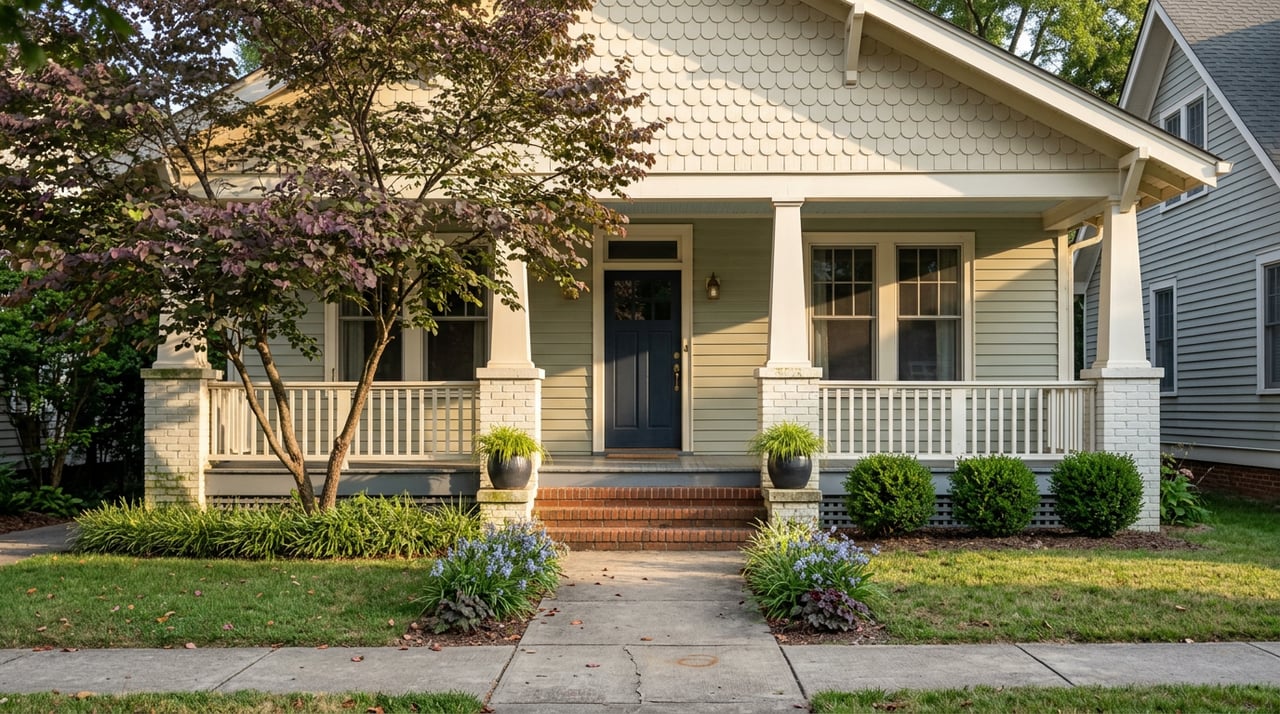
| Del Ray and Rosemont (22301) | Early 20th-century bungalows and Craftsman-style houses along and near Mount Vernon Avenue | An Alexandria Living Magazine analysis of 51 fee-simple closings between January 1 and June 18, 2026 found these two neighborhoods selling faster and closer to asking price than the city, Northern Virginia, and the national market |
| West End and Potomac Yard | Condos, including new construction near the Potomac Yard Metro station and the Virginia Tech Innovation Campus | The segment absorbing most of the region's condo inventory growth, per the same mid-year forecast, with unit sales up sharply even as more units come online |
Three corridors, three housing types, three different sets of buyer behavior. The citywide median sits somewhere in the middle of all of them and matches none of them.
The reason detached inventory keeps shrinking even as detached prices keep climbing isn't really about a wave of new buyers. Alexandria's mid-year forecast projects detached single-family inventory to contract another 9.1% in 2026, with unit sales easing 6.0% as fewer of these homes reach the market at all. The shortfall reads as a supply problem, not a demand one.
That supply problem has a name: the mortgage rate lock-in effect. The Federal Housing Finance Agency estimates it cut national home sales by roughly 1.7 million between 2022 and 2024, a stretch when close to half of all U.S. homeowners were still sitting on mortgage rates below 4%. In a city where the typical detached-home seller is more likely trading up than leaving Alexandria outright, that math keeps the best stock off the MLS entirely. A homeowner with a 2021 mortgage in the low 3% range isn't just weighing a new asking price. They're weighing a new monthly payment against a rate more than double what they're currently carrying, and for a lot of owners the math still doesn't pencil out.
That's the split in one sentence. Detached prices hold or climb because so few detached owners are willing to sell into today's rates, while the condo segment, where owners are less likely to be sitting on an ultra-low mortgage in the first place, absorbs new supply without much resistance.
If the detached market's tight supply is pushing your search toward a condo in the West End or a new tower at Potomac Yard, the price per square foot might look like relief. It can be, but only if you also read the building's reserve study before you read the listing price.
Virginia's Condominium Act requires every condo association in the state to commission a reserve study at least once every five years and to disclose specific figures from it, including current reserves on hand and the amount the study recommends, in the annual budget every owner receives.
That requirement exists because underfunded reserves eventually become somebody's bill. Alexandria's own Housing Affordability Advisory Committee flagged the sharper edge of this in a January 2026 meeting packet: insurance costs for condo buildings are rising and, in some cases, becoming harder to secure at all, and lenders in the secondary mortgage market are increasingly scrutinizing reserve studies, in some cases declining to write loans for buildings whose reserves look thin.
For a buyer, that means the number on the listing sheet isn't the number that decides whether the deal closes. A unit priced well below Old Town's rowhouse market can still fall apart at financing if the building behind it hasn't kept its reserve study current or funded, and that's a document most buyers don't think to ask for until an inspector or a lender raises it first.
Before comparing any two Alexandria properties on price alone, it's worth pulling three things instead of one:
None of this makes Alexandria a bad bet in 2026. It means the citywide number is the least useful piece of information available to you. The market a Del Ray buyer competes in bears almost no resemblance to the one a West End condo buyer is shopping in, and the paperwork that decides whether a deal actually closes looks different in each one. A comparison worth trusting starts with the specific block, the specific building, and, when a condo is involved, the specific reserve study, not the average that gets quoted at dinner parties.
If you're weighing a move within Alexandria, or into it from somewhere else in the DMV, Jesse Oakley can walk through the comps that actually apply to the property in front of you, reserve study included. Book a Consultation before you make an offer on someone else's average.
Does a lower price per square foot in a condo always mean a lower total cost? Not automatically. A condo's monthly fee and its building's reserve funding shape the real cost of ownership as much as the sale price does, and a lender can decline financing over reserve health that never shows up on the listing sheet.
Which part of Alexandria is appreciating fastest right now? Based on closings tracked between January 1 and June 18, 2026, Del Ray and Rosemont sold faster and closer to asking price than Alexandria as a whole, Northern Virginia, and the national market. The mid-year forecast still projects tight supply and firm prices for the detached segment citywide through the rest of 2026, so a slower-moving pocket elsewhere in the city doesn't necessarily mean softer demand, just a different mix of buyers and inventory.
OUR VALUE AND COMMITMENT TO YOU. You work hard to make a statement about yourself, your beliefs, and who you want to become – don't settle for anything less than the best in the business. We value individuality, beauty, transparency, and thought. The homes we are going to show you reflect that. We recommend lenders, contractors, and title companies and have a thorough knowledge of DC neighborhoods.
Let's ConnectCompass
1313 14th St., N.W. Washington, DC 20005