Thinking about buying a fixer-upper in Trinidad or near H Street NE? You are not alone. This part of Washington, DC attracts buyers and investors who want classic rowhouse character, walkable city living, and a chance to create value through smart renovation. If you are weighing whether the numbers, permits, and resale potential make sense, this guide will help you understand the opportunity and the risks. Let’s dive in.
Trinidad and the H Street NE corridor often get grouped together, but they do not always behave the same way. H Street NE is really a corridor, not one single MLS neighborhood, so it makes sense to look at Trinidad alongside nearby areas like H Street-NoMa and Near Northeast when you size up a fixer-upper.
That matters because your renovation path can change block by block. The Office of Planning’s H Street policy area runs from North Capitol to 17th Street NE, and the zoning overlay applies to frontages from 2nd to 15th Street NE. If you are planning exterior work, additions, or a bigger redevelopment play, that policy context can shape what is realistic before you ever swing a hammer.
If you are searching for a lower entry point, Trinidad usually offers the clearest path. In March 2026, Trinidad’s median sale price was $675,000, up 6.4% year over year, with recent sales ranging from a low-end $330,000 rowhouse to renovated homes at $675,000, $735,000, $750,000, $835,000, and $885,000.
Closer to H Street, the numbers shift higher. H Street-NoMa posted a $770,000 median sale price in March 2026, while Near Northeast came in at $815,000. That tells you something important right away: the closer you get to the core corridor, the tighter the spread may be between your purchase price and your likely resale ceiling.
For many buyers, Trinidad is where the value-add math looks more forgiving. Based on recent sales, sub-$500,000 opportunities still appear there, especially for homes that need meaningful work. That creates more room to absorb renovation costs and still land below the top of the neighborhood’s renovated sales range.
H Street-NoMa can still offer opportunity, but the baseline pricing is often higher. The area also showed some year-over-year softness, which may create a bit more negotiating room. Even so, you should be careful not to buy at a price that assumes a perfect exit in an already renovated price band.
A lot of the housing stock in Trinidad is older rowhouse product, with many homes dating back to the 1920s. That can be part of the appeal. You may find original brick facades, deeper lot potential, and layouts that reward thoughtful redesign.
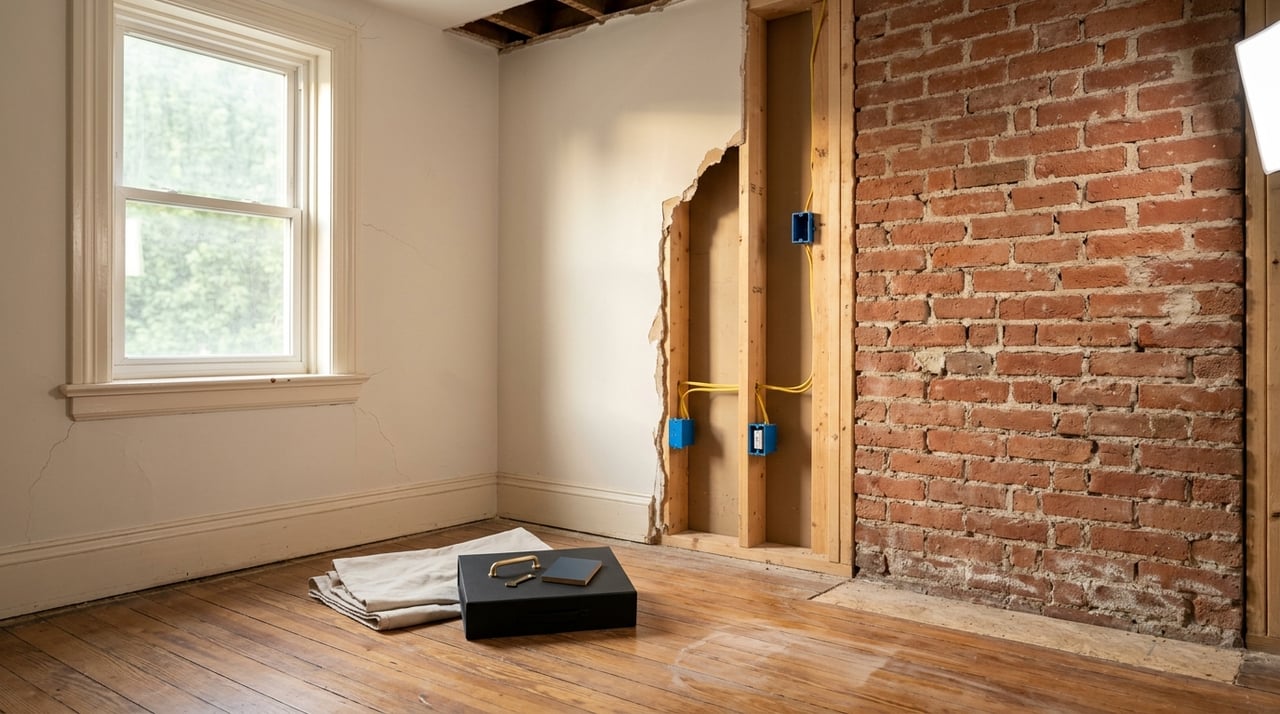
Older homes also bring more unknowns. Behind the walls, you may be dealing with aging systems, structural issues, or surprises that affect both budget and timeline. In this part of DC, the smartest investors go in expecting more coordination between architect, contractor, lender, and permit reviewers.
This is where local knowledge matters. In DC, interior kitchen and bath remodels and similar updates generally fall under an Alteration & Repair permit, and every project needs a cost estimate. One- and two-family homes can use the DOB Permit Wizard, which is helpful for planning your path early.
But many fixer-uppers go beyond cosmetic work. DC states that all structural work and some nonstructural work require building permits. If the property sits in a historic district, you may also need a Historic Property - Special Permit, even when the job looks straightforward at first glance.
The H Street overlay was designed to encourage residential use, upper-floor reuse, and design approaches that fit the corridor’s historic character. It also allows bonus density for certain new construction projects that preserve an existing facade built before 1958.
For you, that means facade changes and addition-heavy projects need more than a rough contractor estimate. You need a preservation-aware plan from the start. If your investment strategy depends on adding density or changing the exterior in a major way, underwriting should include that entitlement and design risk upfront.
A fixer-upper deal can look great on paper and still fall apart if your assumptions are too aggressive. In Trinidad, renovated rowhouses are already trading in roughly the $675,000 to $885,000 range. In H Street-NoMa, rowhouse sales have clustered around $590,000 to $867,500, with some premium outliers above that.
The practical lesson is simple: buy below the renovated band, not at the top of it. If you pay too much on the way in, your margin can disappear fast once you factor in permits, carrying costs, construction surprises, and resale timing.
Your hold costs matter just as much as your renovation budget. DC’s Class 1A residential property tax rate is $0.85 per $100 of assessed value. At that rate, a $675,000 assessment works out to about $5,738 per year before deductions, while an $815,000 assessment comes to about $6,928.
That may not make or break a project on its own, but it belongs in your numbers. The longer your timeline stretches, the more those carrying costs matter. This is especially true if permits or inspections move slower than expected.
Not every fixer-upper should be flipped. In some cases, a rental hold may be the stronger long-term play. Trinidad’s average apartment rent was reported at $1,913 as of April 2026, with typical one-, two-, and three-bedroom rents at $1,913, $2,311, and $2,668.
H Street’s averages run higher. The area reported an average apartment rent of $2,360, with typical one-, two-, and three-bedroom rents of $2,358, $3,483, and $4,773. That gap helps explain why well-located and well-renovated housing near the corridor can attract strong tenant interest.
The appeal is not just about the housing itself. Trinidad is noted as very walkable with strong public transit, while H Street-NoMa has a Walk Score of 95 and reports roughly 28,593 jobs in the neighborhood. Those factors support demand from renters who value access to jobs, transit, and city amenities.
House rental snapshots also show that rowhouses can perform differently from apartment averages. In Trinidad, current examples include around $1,750 for a two-bedroom and roughly $3,500 to $4,995 for three-bedroom houses. Near H Street, examples include about $3,000 for a two-bedroom, $2,695 for a three-bedroom, and $4,600 for a four-bedroom.
If you plan to hold the property as a rental, you need to understand DC’s local rules before making assumptions about rent growth. DC says rent control applies to rental housing accommodations citywide, and all rental units must be registered. If a unit is not registered, rent control applies automatically.
There are exemptions, including many units built after 1975 and units owned by a natural person who owns no more than four rental units in the District. Since much of the rowhouse stock in Trinidad and along H Street predates 1975, you should verify exemption status rather than assume your property is exempt.
TOPA can also affect your exit strategy. DC states that tenants generally get the first opportunity to buy when a building is sold, though most single-family dwellings are exempt. The RENTAL Act of 2025 added new exemptions and a 45-day assignment wait period in some situations, and the owner has the burden of proving an exemption.
That is especially important if your long-term plan includes multiple units, condo-style resale, or ownership through an entity. In those cases, legal review should be part of your planning, not a last-minute fix.
Most fixer-upper buyers in Trinidad and near H Street are looking at one of three paths:
The best choice depends on your budget, your timeline, and your tolerance for permitting risk. If you want a more predictable path, a classic rowhouse renovation with a clear resale or rental plan may be the strongest fit. If you are chasing added density or major reconfiguration, the local overlay and permit process become a much bigger part of the investment itself.
In this part of DC, your numbers are only as good as your team. You need a lender who understands renovation draws and DC closing costs, a contractor who knows how DOB permitting works, and an agent who can read the difference between a true value opportunity and a property that only looks cheap at first glance.
That is where neighborhood knowledge and technical fluency really pay off. In older DC rowhouses, architecture, construction, preservation, and pricing are all connected. A smart strategy starts with seeing those connections before you write the offer.
If you are exploring a fixer-upper in Trinidad or near H Street NE, working with someone who understands both the market and the renovation process can save you time, money, and unnecessary risk. When you are ready to evaluate a property or pressure-test your numbers, connect with Jesse Oakley for informed, local guidance.
OUR VALUE AND COMMITMENT TO YOU. You work hard to make a statement about yourself, your beliefs, and who you want to become – don't settle for anything less than the best in the business. We value individuality, beauty, transparency, and thought. The homes we are going to show you reflect that. We recommend lenders, contractors, and title companies and have a thorough knowledge of DC neighborhoods.
Let's ConnectCompass
1313 14th St., N.W. Washington, DC 20005